

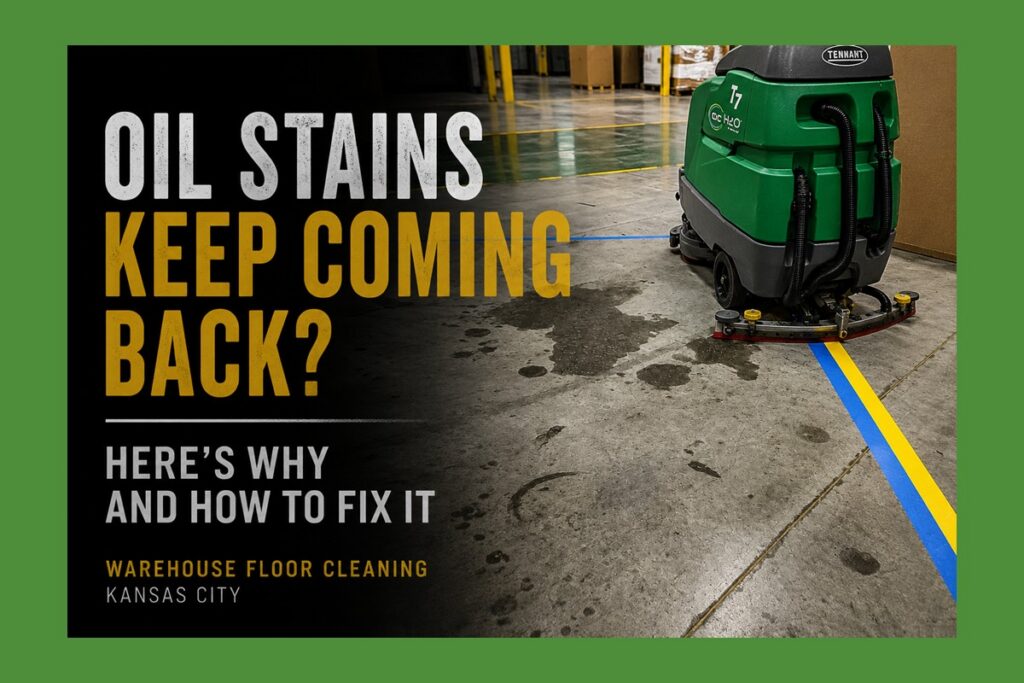
Does Your Warehouse Floor Look Dirty No Matter How Often It’s Cleaned?
Many warehouse managers in Kansas City face the same frustrating problem.
The floor gets cleaned.
The oil stain disappears.
A few days later, the stain is back.
The janitorial crew cleans it again.
The stain comes back again.
At some point, everyone starts believing that’s just how warehouse floors look.
The truth is, many oil stains are never actually removed.
They are simply cleaned from the surface while contamination remains trapped deep inside the concrete.
Why Warehouse Floors Develop Permanent-Looking Stains
Most warehouse concrete floors are porous.
Think of concrete like a sponge.
When oil, grease, hydraulic fluid, or industrial lubricants spill onto the surface, they begin soaking into the concrete.
Over time, the contamination penetrates below the surface.
Once that happens, routine scrubbing and mopping are often unable to fully remove the problem.
The contamination remains inside the concrete and slowly migrates back to the surface.
This is why many warehouse floors appear clean immediately after cleaning but look stained again a few days later.
Not All Oil Stains Are the Same
Before successful stain removal can occur, the contamination must be identified.
Different contaminants require different treatment methods.
🌿 Organic Oil Contamination
Examples include:
- Food oils
- Vegetable oils
- Animal fats
- Food processing residue
🛢 Petroleum-Based Contamination
Examples include:
- Hydraulic fluid
- Motor oil
- Lubricants
- Grease
- Gear oils
- Industrial petroleum products
Knowing what type of contamination is present helps determine the correct cleaning chemistry and restoration process.
Using the wrong method often leads to disappointing results.
Why Degreasers and General Cleaners Often Fail
Many warehouse teams rely on products such as:
- Simple Green
- General-purpose degreasers
- Maintenance cleaners
- Floor detergents
These products are designed primarily for surface cleaning.
They remove dirt and contamination that is sitting on top of the floor.
What they typically do not do is remove contamination that has already penetrated into the concrete.
As a result:
❌ The floor looks cleaner temporarily.
❌ The contamination remains.
❌ The stain returns.
❌ The cleaning cycle repeats.
The real problem was never solved.
Why Some Warehouse Floors Stain More Than Others
One of the most overlooked causes of recurring stains is the lack of concrete protection.
Many industrial floors either:
- Never received a protective treatment.
- Have worn-out sealers.
- Have damaged surface protection.
- Have lost protection due to years of traffic and scrubbing.
Once the protective barrier is gone, contaminants can penetrate much more easily.
Unprotected concrete can absorb:
🔴 Hydraulic oil
🔴 Motor oil
🔴 Grease
🔴 Coolants
🔴 Food oils
🔴 Industrial chemicals
The deeper the contamination penetrates, the more difficult it becomes to remove.
Why Oil Contamination Creates Safety Concerns
Oil stains are not just an appearance issue.
They can also create safety hazards.
Residual contamination may lead to:
⚠️ Slippery walking surfaces
⚠️ Reduced traction
⚠️ Forklift tire slippage
⚠️ Increased fall risks
⚠️ Housekeeping concerns
⚠️ Safety audit findings
Many warehouse floors appear dry but still contain residual oils that affect slip resistance.
This is one reason proper contamination removal is so important.
The Difference Between Cleaning and Restoration
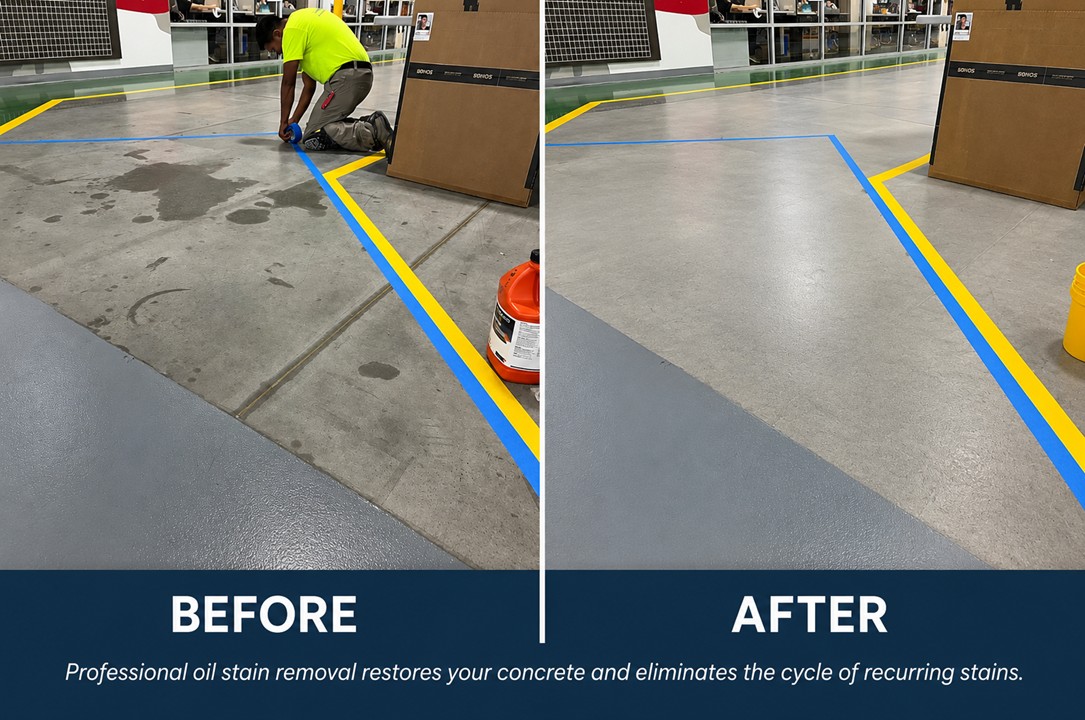
Routine cleaning focuses on removing surface dirt.
Industrial floor restoration focuses on removing contamination from within the concrete itself.
Successful oil stain removal often requires:
✅ Identification
Determining the type of contamination present.
✅ Specialized Treatment
Using chemistry designed for the specific contaminant.
✅ Extraction
Pulling contamination from the concrete rather than simply moving it around.
✅ Rinsing
Removing residues and contaminants from the surface.
✅ Evaluation
Determining whether additional treatments are needed.
In severe situations, multiple treatments may be necessary to fully restore the affected area.
Why Most Janitorial Programs Are Not Designed for This
Janitorial companies perform an important role.
Their focus is routine maintenance.
Typical janitorial programs are designed for:
- Dust removal
- Mopping
- Surface cleaning
- Daily appearance maintenance
Industrial contamination removal often requires:
- Specialized equipment
- Extraction systems
- Industrial cleaning chemistry
- Concrete restoration knowledge
- Surface protection expertise
These are very different services.
Protecting the Floor After Cleaning
Removing contamination is only part of the solution.
Once the floor is restored, the next step is preventing future contamination.
In many facilities, this involves applying an appropriate concrete sealer or protective treatment.
Benefits may include:
✔ Reduced oil absorption
✔ Easier cleaning
✔ Improved appearance
✔ Lower maintenance costs
✔ Longer floor life
Without protection, contaminants can simply begin penetrating the concrete again.
Signs Your Warehouse Floor Needs Professional Attention
🟥 Oil stains keep returning
🟥 Hydraulic fluid contamination
🟥 Slippery floors
🟥Dark spots in traffic lanes
🟥 Grease buildup
🟥 Repeated degreasing with little improvement
🟥 Concrete dusting
🟥 Unsealed concrete surfaces
🟥 Areas around equipment remain stained
🟥 Safety concerns related to contamination
Warehouse Floor Cleaning and Oil Stain Removal in Kansas City
Many recurring warehouse floor problems are not caused by poor housekeeping.
They are caused by contamination that has penetrated deep into unprotected concrete.
The solution is not always more scrubbing.
The solution is identifying the contamination, removing it properly, and protecting the concrete against future absorption.
About Advanced 360 Total Floor Care
Advanced 360 Total Floor Care specializes in warehouse floor cleaning, industrial concrete floor restoration, oil stain removal, concrete degreasing, warehouse floor sealing, manufacturing facility floor cleaning, and industrial floor maintenance throughout Kansas City and surrounding areas.
If your warehouse floor continues to look dirty no matter how often it is cleaned, schedule a complimentary Industrial Floor Assessment and discover whether contamination beneath the surface is the real problem.
➜ Explore our Commercial Floor Care Services in Kansas City to see how Advanced 360 Total Floor Care can help protect your facility’s floors.
FAQs
Why do oil stains keep coming back after my warehouse floor is cleaned?
- Concrete is naturally porous, so oil, grease, and hydraulic fluids can soak below the surface over time. Routine cleaning often removes only the contamination on top of the concrete, while oil trapped deeper in the slab can gradually migrate back to the surface. That’s why stains may reappear days or weeks after cleaning.
Can old oil stains be removed from a concrete warehouse floor?
- In many cases, yes. The success of the cleaning depends on the type of contamination, how deeply it has penetrated the concrete, and the condition of the floor. Professional restoration methods use specialized cleaning chemistry and extraction techniques designed to remove embedded contamination rather than simply cleaning the surface.
How can I prevent new oil stains from penetrating my warehouse floor?
- After the floor has been properly cleaned and restored, applying an appropriate concrete sealer or protective treatment can help reduce future oil absorption. Protective treatments make routine cleaning easier, improve the appearance of the floor, and help extend the life of the concrete by limiting how deeply contaminants can penetrate.

Dana writes about commercial cleaning, healthcare environmental services, and professional floor care for Kansas City facilities. Through Advanced 360 Total Floor Care and Sani-SAFE Healthcare in Lenexa, Kansas, Dana shares real-world guidance on facility maintenance, infection prevention, floor preservation, inspection readiness, and creating cleaner, safer environments.