

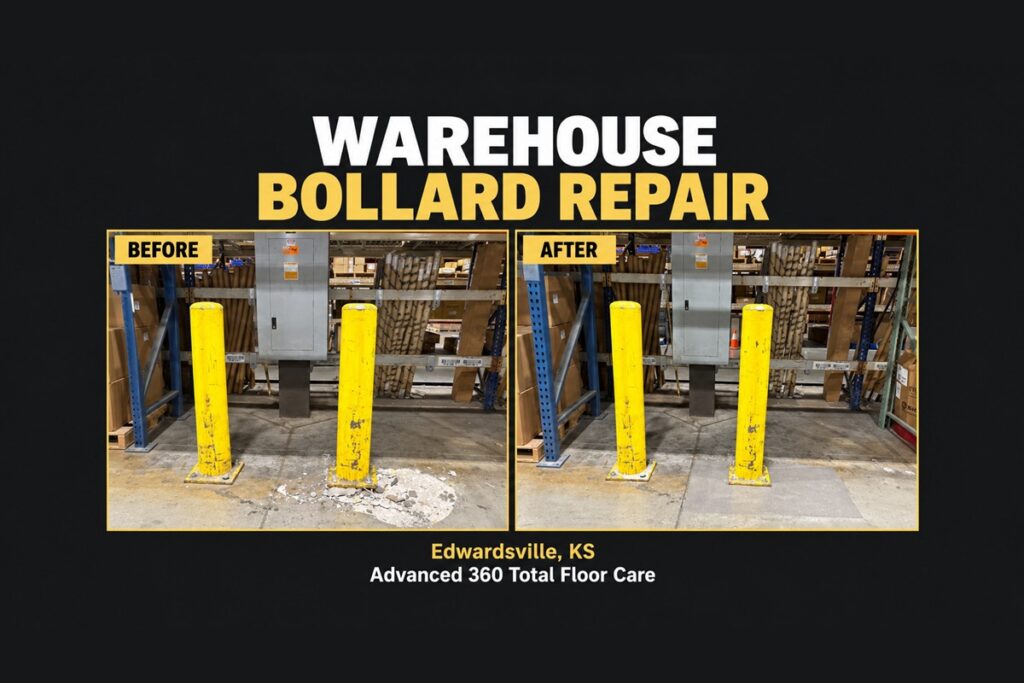
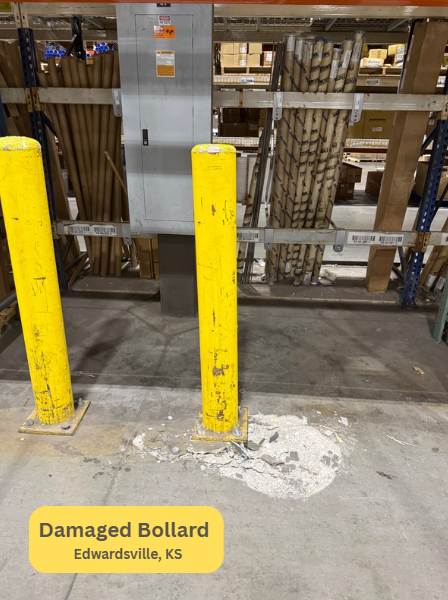
A warehouse bollard that moves, leans, or pulls concrete from the slab is no longer a simple maintenance item. The post may be bent, the base plate may be distorted, the anchors may have failed, and the concrete below the surface may be cracked or broken. Tightening the same bolts or packing a generic patch around the base can hide the damage without restoring the attachment.
A reliable repair begins with the bollard’s purpose. A post protecting a pedestrian route, rack end, dock door, electrical panel, fire equipment, or production asset may need a different design and level of review. The contractor should inspect the steel and slab, identify the failure, verify the concrete before drilling, rebuild unsound areas with a suitable repair system, install the specified anchors correctly, and state when the area can safely return to service.
Why Warehouse Bollards Fail After Forklift Impacts
A forklift strike can load the post far above the force produced by normal contact. The visible bend is only part of the story. Impact can stretch base-plate holes, shear a bolt, pull an anchor from the slab, break a cone of concrete around the embedment, or create cracks that extend beyond the patch. Repeated lighter strikes can also loosen a connection over time.
Some failures begin with the original installation. An anchor may be too small or too shallow for the demand. A hole may be oversized, poorly cleaned, too close to an edge or joint, or tightened incorrectly. Adhesive anchors may be loaded before the adhesive cures. Mechanical anchors may be placed in concrete that is cracked, thin, or too weak for the selected product. A repair must address the actual failure instead of duplicating the original detail.
Different Bollard Systems Need Different Repairs
● Surface mounted bollards
- A surface-mounted bollard uses a welded base plate and post-installed anchors. The inspection should check the post, welds, plate flatness, bolt holes, washers, nuts, grout or bedding, anchors, and concrete. If the plate is bent or its holes have torn or elongated, installing larger washers is not a dependable substitute for replacing or properly repairing the steel assembly.
● Embedded bollards
- An embedded or core-set bollard extends below the floor and is surrounded by concrete or grout. Repair may require removing a larger section of slab, confirming embedment and below-slab conditions, installing a new post, and restoring the floor section. A surface patch around a loose embedded post will not correct movement below the floor.
● Removable bollards and connected guards
- Removable bollards rely on sleeves, receivers, locks, or covers that can deform or fill with debris. Rack guards, guardrails, handrails, and equipment barriers may look similar but have different components and design requirements. The contractor should identify the complete system before choosing a repair detail.
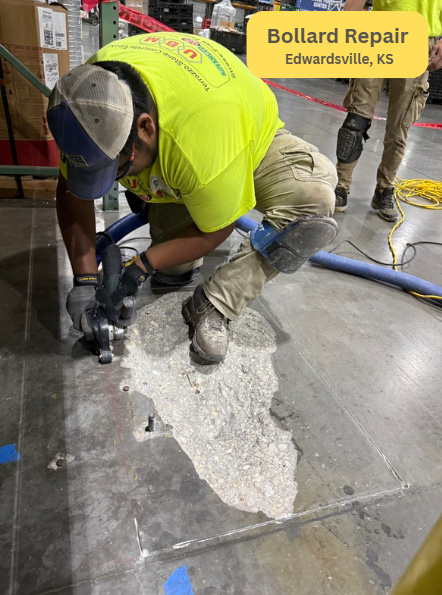
What the visible damage may be telling you . . .
The surface condition helps direct the inspection, but it does not prove what happened below the slab. The repair scope should be based on exposed and verified conditions.
| Visible condition | Possible source | Repair direction |
| Loose or wobbling post | Anchor loosening, base-plate movement, cracked concrete, or failed bedding | Restrict exposure and inspect the plate, anchors, torque, and surrounding slab |
| Missing or sheared bolt | Impact overload, corrosion, fatigue, or an installation problem | Remove the bollard and determine whether the anchor and base plate can be reused |
| Concrete cone or chunk pulled out | Concrete breakout, inadequate embedment, edge distance, spacing, or weak substrate | Map the damage and design a concrete and anchorage repair rather than filling the hole |
| Cracked or spalled concrete | Impact damage, hidden delamination, weak concrete, or a failed previous patch | Remove unsound material to sound concrete and determine the full repair limits |
| Bent post or base plate | Steel deformation from impact | Replace or obtain an engineered repair; do not assume the assembly can be straightened |
| Rust at the base | Water, deicing salts, washdown chemicals, damaged coating, or trapped moisture | Inspect section loss, steel condition, drainage, coating, and anchor corrosion |
| Patch separating from the slab | Poor preparation, contamination, wrong thickness, shrinkage, or incompatible material | Remove the failed patch and rebuild with a repair material suited to the geometry |
| Anchor spins during tightening | Damaged or oversized hole, weak concrete, debris, or failed adhesive | Stop tightening and evaluate the hole and substrate before selecting a new anchor detail |
| Repeated hits in one location | Travel path, visibility, turning radius, speed, or barrier layout problem | Repair the damage and review traffic controls or protective layout |
| Damage beside a joint or slab edge | Reduced concrete confinement and a larger slab repair need | Review joint movement, edge distance, load path, and repair geometry before drilling |
Why Generic Maintenance Repairs Often Fail
A maintenance crew may need to make an area safe quickly, but common short-term methods are not automatically suitable as a final repair. Thin ordinary concrete around a damaged anchor hole can crack or de-bond. A surface skim does not replace the broken concrete that carried the anchor load. A standard bolt does not become an anchor merely because it fits through the base plate.
Other failure points include drilling the wrong diameter, using shallow embedment, failing to clean the hole, placing an anchor too close to a joint or damaged edge, installing into weak repair material, reusing a bent plate, or loading the connection before the repair mortar or anchoring adhesive reaches the required strength. The exact anchor, hole preparation, embedment, spacing, edge distance, installation torque, cure, and allowable load should come from a verified design and the current manufacturer instructions.
What Should Be Verified Before Drilling
The contractor should confirm slab thickness and condition before selecting anchor length or embedment. Existing drawings can help, but field verification may still be needed. When reinforcement, post-tensioning, electrical conduit, heating, or other embedded systems may be present, the slab should be reviewed and scanned as appropriate before new holes are drilled.
The layout must also account for nearby joints, slab edges, previous holes, the repair boundary, reinforcement, and the base-plate pattern. Depending on what the bollard protects and the consequences of failure, an engineer, anchor manufacturer representative, or authority having jurisdiction may need to review the detail. No single anchor or bolt specification is correct for every warehouse bollard.
How Professional Bollard Repair Should Proceed
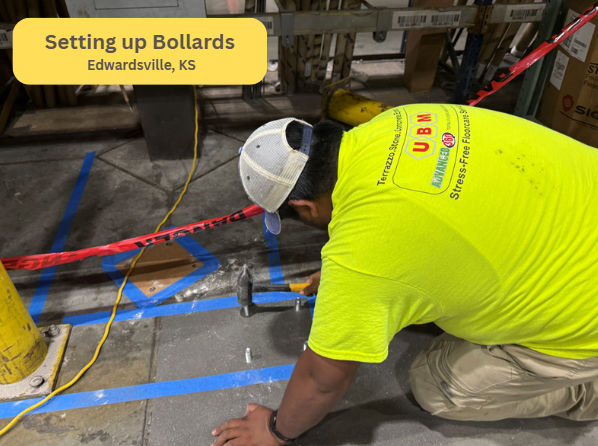
The approved sequence depends on the bollard system, slab, repair material, anchor design, and operating schedule.
A professional project normally includes these steps.
- Secure the area Use the facility’s safety and traffic-control procedures, protect people and assets, and keep forklifts away from a barrier that may no longer function as intended.
- Document the condition Photograph the post, base plate, anchors, cracks, concrete loss, nearby joints, prior patches, corrosion, alignment, and evidence of repeated impact.
- Confirm what the bollard protects Identify the pedestrian route, rack, dock, door, utility, machine, or other asset and determine whether the original location and performance requirement remain appropriate.
- Identify the bollard system Determine whether it is surface mounted, embedded, removable, or part of a guardrail, then inspect the steel, welds, plate, sleeves, and connected components.
- Inspect the slab and repair limits Map cracks, sounding changes, spalls, delamination, contamination, joint damage, and concrete breakout so all unsound material is included.
- Review drawings and scan when needed Verify slab thickness and locate reinforcement, post-tensioning, conduits, or other embedded items before demolition or drilling where conditions require it.
- Remove the damaged assembly Take out failed anchors and lift the bollard without enlarging the damage unnecessarily. Tag reusable components only after they pass inspection.
- Remove unsound concrete Sawcut or chip the repair perimeter as appropriate, remove weak and fractured material to sound concrete, and protect reinforcement and adjacent work.
- Prepare the repair substrate Clean contamination and dust, create the required surface profile, condition the concrete, and treat exposed steel according to the selected repair system.
- Rebuild the slab section Place and consolidate a high-strength repair material selected for the depth, geometry, environment, load, and required return-to-service time. Follow its water, mixing, placement, and curing limits.
- Verify strength before anchoring Do not assume that fast setting means immediately ready for drilling or loading. Confirm the repair material’s required age and strength and whether the anchorage design permits installation in the repaired zone.
- Lay out and drill the anchors Use the specified diameter, depth, spacing, edge distance, and drilling method. Keep holes away from unsuitable old holes, damaged edges, joints, and embedded items.
- Clean and install the anchor system Follow the exact cleaning sequence and installation instructions for the selected mechanical or adhesive anchor, including temperature limits, embedment, torque, and adhesive cure.
- Set and align the bollard Install the inspected or replacement assembly plumb and aligned, provide specified bedding or grout, tighten in the required sequence, and protect the work from movement.
- Inspect and reopen the area Confirm alignment, fastener installation, cure or strength, finish, striping, cleanup, and photo documentation. Reopen traffic only at the written time established for the complete repair system.
Mechanical and Adhesive Anchors Require a Design Choice
Mechanical anchors and adhesive anchors can both be appropriate when they are selected and installed for the actual concrete, loads, spacing, edge distance, temperature, and exposure. The best choice depends on more than speed. Cracked or uncracked concrete qualification, corrosion resistance, installation direction, hole condition, required embedment, cure time, inspection, and future replacement can all affect the decision.
Hole cleaning is especially important for many adhesive systems. Dust and debris can reduce bond and must be removed with the tools and sequence stated in the installation instructions. Adhesive anchors also have temperature-dependent working and cure times. The post should not be torqued or loaded before the system is fully cured. Mechanical anchors have their own hole tolerances, installation torque, spacing, edge-distance, and concrete-strength requirements.
Fast Return to Service Still Requires Cure Time
Warehouses rarely have the luxury of shutting down an aisle or dock for several days. Rapid-setting repair materials can reduce the closure when they are appropriate for the repair depth and operating conditions. However, the concrete repair and the anchor system follow separate schedules. A repair mortar may gain strength quickly while an adhesive anchor still requires additional cure, especially in cold conditions.
A responsible reopening plan states the time for finishing, curing, drilling, anchoring, tightening, pedestrian access, and forklift traffic. Temporary barriers, alternate routes, off-hours work, and phased repairs can keep the warehouse operating. The final reopening time should come from the current technical data for every installed component and the verified field conditions, not from the phrase rapid set on a bag.
When to Repair the Bollard and When to Replace it
A straight post with intact welds, a flat base plate, sound holes, and limited connection damage may be reusable after inspection. A bent post, cracked weld, distorted plate, elongated hole, significant corrosion, or unknown internal damage often points toward replacement. Straightening visibly damaged steel without a qualified evaluation can leave reduced capacity or hidden cracking.
The concrete decision is separate. Local damage may accept a properly detailed repair, while widespread cracking, joint failure, a thin slab, repeated breakout, or damage close to an edge may require a larger slab repair or a different protective detail. If forklifts repeatedly hit the same post, the project should also review visibility, travel path, turning radius, striping, speed control, and the barrier layout.
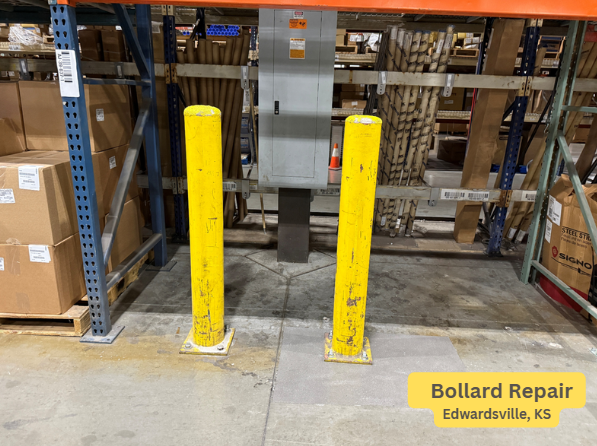
Questions to ask a warehouse bollard repair contractor
- Purpose and performance What does this bollard protect, and how will that use affect the repair or replacement detail?
- Steel condition Can the post and base plate be reused, or do bending, torn holes, weld damage, or corrosion require replacement?
- Concrete condition How will you find cracks, delamination, weak patches, breakout, and the full limits of unsound concrete?
- Slab verification How will you confirm slab thickness and locate reinforcement, post-tensioning, conduits, or other embedded systems before drilling?
- Removal and preparation How will you remove failed anchors and concrete, prepare the repair edges and substrate, and protect nearby joints?
- Repair material Which product will be used, what repair thickness does it permit, and what preparation, water, consolidation, temperature, and curing requirements apply?
- Strength and schedule When can the repair be drilled, anchored, torqued, and opened to forklift traffic under the expected temperature and site conditions?
- Anchor design What anchor type, diameter, embedment, spacing, edge distance, material, and concrete qualification will be used, and what supports that selection?
- Hole preparation What drilling and cleaning procedure will you follow, and how will the crew verify hole diameter, depth, and cleanliness?
- Installation control What torque, adhesive working time, cure time, inspection, and documentation are required for the selected system?
- Operational control How will you phase the work, maintain alternate routes, control dust and debris, protect the repair, and clean the area each day?
- Written scope Will the proposal define quantities, repair limits, materials, assumptions, exclusions, reopening times, photos, warranty, and any engineering responsibility?
Warning signs when comparing contractors
Be cautious when a contractor:
- Quotes the final repair from photographs without inspecting the steel, anchors, and slab
- Patches over loose or fractured concrete instead of removing it to sound material
- Plans to reuse a bent post, distorted base plate, torn hole, or damaged weld without evaluation
- Uses the same generic bolt or anchor for every bollard and every slab condition
- Has no method to verify slab thickness or avoid reinforcement, post-tensioning, and utilities
- Cannot provide current repair-material and anchor installation requirements
- Does not describe hole diameter, depth, cleaning, embedment, torque, cure, or edge distance
- Promises immediate forklift traffic because the product is fast setting
- Provides no traffic-control, protection, cleanup, inspection, or written reopening plan
- Calls the repair permanent or forklift proof without defining the design basis and limitations
What affects the cost of bollard repair
Cost depends on the number and type of bollards, post and base-plate size, steel replacement, concrete breakout volume and depth, slab thickness and condition, reinforcement, proximity to joints or edges, scanning, anchor system, repair material, curing and protection, forklift access, temporary barriers, off-hours work, striping, paint, disposal, and phasing. A loose bolt in sound concrete is a different project from an uprooted bollard that removed a large slab section.
A useful proposal separates known work from conditions that can only be confirmed after removal. It should state unit prices or approval steps for additional concrete damage, hidden steel damage, a thin slab, conflicting embedded items, or a larger repair area. That clarity helps the facility compare scopes rather than selecting a low price built on missing work.
How to reduce future bollard damage
A repaired bollard still needs routine inspection and a traffic plan. Facility teams should record impacts instead of waiting for a post to lean or pull out. Repeatedly tightening anchors in cracked concrete can enlarge the damage and make the next repair more difficult.
- Inspect posts, base plates, nuts, washers, welds, cracks, patches, rust, and alignment on a set schedule
- Remove a damaged barrier from service or protect the exposure according to the facility safety plan
- Document forklift strikes with photographs, location, date, and observed movement
- Keep bollards visible with maintained paint, reflective markings, lighting, and clear floor striping
- Review forklift routes, speed, turning space, blind corners, dock approaches, and driver training
- Keep stored materials and pallets from narrowing the designed travel path
- Check vulnerable rack ends, dock doors, pedestrian crossings, utilities, and control panels for recurring impact patterns
- Do not keep tightening a loose anchor when the base plate moves or the surrounding concrete is broken
Bollard repair should not become your second job
Facility managers should not have to select an anchor from a catalog, supervise demolition, interpret cure tables, or chase several vendors for one damaged location. A well-managed project provides one accountable contact, a written repair sequence, phased scheduling, dependable updates, traffic controls, daily cleanup, photo documentation, reopening criteria, and a final walkthrough.
Advanced 360 Total Floor Care Systems helps Kansas City warehouses coordinate bollard and related concrete repairs around active operations. We inspect the visible failure, define the repair limits, coordinate the selected materials and anchorage requirements, document the work, and provide a written 12-month workmanship warranty for the work covered by the proposal. Our Pain-Free Service approach is designed to reduce the amount of follow-up the facility manager must provide.
Warehouse bollard repair help in Kansas City
If a forklift has bent, loosened, or uprooted a warehouse bollard, start with an on-site assessment. Send the facility location, photographs, number of bollards, what each bollard protects, approximate post and base-plate dimensions, slab information, previous repair history, access restrictions, and the time window available for service. Advanced 360 can help separate steel replacement, concrete repair, anchoring, traffic control, and reopening requirements into a clear scope.
Frequently Asked Questions
Can a loose warehouse bollard just be tightened?
- Only when an inspection confirms that the bollard, base plate, anchor, and surrounding concrete remain sound and the anchor can be tightened according to its instructions. If the plate moves, the anchor spins, or the concrete is cracked or broken, tightening can hide or worsen the failure.
Can the old anchor holes be reused?
- Sometimes, but not by assumption. The contractor must evaluate hole condition, diameter, depth, spacing, edge distance, concrete damage, and the requirements of the proposed anchor system. An oversized, cracked, contaminated, or damaged hole may need a different engineered detail.
Is rapid setting concrete suitable for bollard repair?
- It can be when the product is appropriate for the repair thickness, substrate, environment, loading, and anchorage plan. The crew must remove unsound concrete, prepare the substrate, mix and place the material correctly, cure it as required, and wait for the specified strength before drilling or loading.
How soon can forklifts return to the repaired area?
- The answer depends on the repair material, temperature, repair depth, anchor type, adhesive cure if used, bollard installation, and required loading. The proposal should provide separate milestones for curing, drilling, anchoring, protection, and forklift traffic rather than one generic fast-set time.
Are mechanical anchors or adhesive anchors better?
- Neither type is universally better. Selection depends on the design load, concrete condition, slab thickness, cracks, spacing, edge distance, corrosion exposure, temperature, installation access, inspection, and return-to-service schedule. Use a qualified system supported by current technical data.
Can a bent bollard be straightened and reused?
- A visibly bent post or base plate may have stretched steel, cracked welds, distorted holes, or other hidden damage. Reuse should follow a qualified evaluation. Replacement is often the clearer choice when the steel assembly has permanent deformation.
Does every bollard repair need an engineer?
- Not every minor maintenance condition requires the same review. Engineering input becomes more important when the bollard protects people or critical assets, the required impact performance is defined, the slab is thin or damaged, anchorage is near an edge or joint, hidden systems are present, or the original detail repeatedly fails.
Why does the same bollard repair keep failing?
- Recurring failure can come from repeated forklift impacts, a poor travel path, damaged steel, unsound concrete, inadequate embedment, wrong anchor selection, poor hole cleaning, insufficient spacing or edge distance, premature loading, or a repair material that does not match the depth and service conditions.
Can bollards be repaired without shutting down the warehouse?
- Often, the work can be phased with temporary barriers, alternate forklift routes, off-hours scheduling, dust control, and protected cure zones. The affected area must remain isolated until the repair material and anchor system meet their stated reopening requirements.
Should anchors be installed into the new repair material?
- That decision belongs in the repair and anchorage design. The contractor must confirm that the repair material, placement, age, strength, thickness, and connection to the original slab support the selected anchor. Some conditions call for anchoring into sound existing concrete, a qualified repaired zone, or a different embedded detail.
What if the damage is beside a floor joint or slab edge?
- Concrete near a joint or edge may provide less confinement around an anchor and may continue to move. The project may require a larger concrete repair, a revised base-plate or anchor layout, relocation, or engineering review. Filling the breakout without addressing the joint or edge condition can lead to another failure.
Can several bollards be repaired in phases?
- Yes. The facility can group repairs by risk, aisle, dock, or production area and maintain alternate routes with temporary protection. Each location should have its own inspection, cure, anchor installation, and reopening record so traffic is not released onto unfinished work.
What documentation should the facility receive?
- Closeout records should identify the repaired locations, bollards, concrete repair material, anchor system, installation requirements, curing and reopening times, approved changes, photographs, final inspection, maintenance recommendations, and the warranty that applies to the completed scope.

Dana writes about commercial cleaning, healthcare environmental services, and professional floor care for Kansas City facilities. Through Advanced 360 Total Floor Care and Sani-SAFE Healthcare in Lenexa, Kansas, Dana shares real-world guidance on facility maintenance, infection prevention, floor preservation, inspection readiness, and creating cleaner, safer environments.